
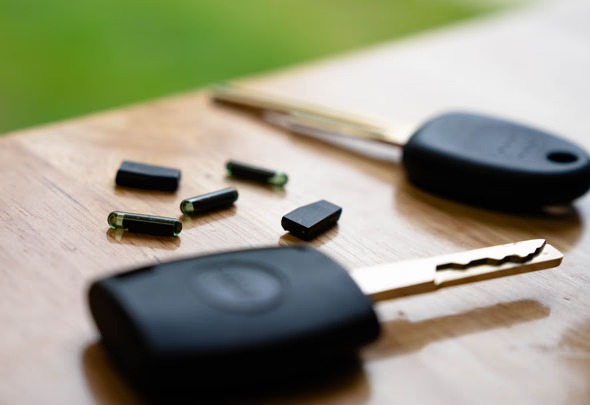
Vehicle security has changed dramatically over the past few decades. Gone are the days when a simple metal key was enough to start any vehicle. Today, most modern vehicles rely on a transponder system that helps prevent car theft by ensuring only the right key can start the engine.
A transponder chip is a small electronic microchip hidden inside the key or integrated into a key fob. When you insert the car key into the ignition or use a smart key with keyless entry, the chip communicates with the vehicle’s immobiliser. If the code stored on the chip matches the one programmed into the vehicle, the engine starts normally. If it doesn’t, the vehicle remains immobilised and the car won’t start.
Over the years, car manufacturers have introduced many different transponder technologies. Some were designed for older cars and use simple fixed codes, while others use sophisticated encrypted communication to provide an added layer of security. Understanding these different chip technologies and the common chip families can help you choose the correct new car key, simplify key replacement, and avoid unnecessary trips to the local dealership.
A transponder chip is a passive RFID device built into a transponder car key. Unlike a battery-powered remote, the chip doesn’t require its own power source to identify itself. Instead, when you insert the car key and turn it in the ignition, an antenna coil around the ignition produces an electromagnetic field that briefly powers the chip.
The key transponder chip immediately sends back its unique encrypted identification code. The vehicle’s immobiliser compares this information with the corresponding transponder code stored in its computer. If the code matches the stored one, the immobiliser authorises the fuel and ignition systems, allowing the engine to start.
If the wrong chip is detected—or if the key has no chip at all—the vehicle refuses to start. In many cases, a warning light on the dashboard indicates an immobiliser fault. Even though the mechanical key or metal key may physically fit the locks and turn the ignition, the engine won’t start because the security system cannot verify the key.
This technology has become one of the most effective methods of theft prevention, making hot-wiring virtually impossible on vehicles fitted with electronic immobilisers.
Every transponder is programmed to a specific vehicle. During key programming, a specialist stores encrypted security information on the chip so the chip can communicate with the vehicle.
When you turn the key or turn the ignition, several things happen within a fraction of a second:
The antenna around the ignition energises the transponder.
The chip inside the key transmits its encrypted identification code.
The immobiliser system checks whether the code is authorised.
If the key is programmed correctly, the vehicle detects the approved key and the system allows the engine to start.
If authentication fails, the engine remains disabled, and the vehicle won’t start.
This process runs automatically every time you start your car, providing drivers with a seamless experience while significantly reducing the risk of vehicle theft.
Although many people refer to chips such as ID46 or ID48 as different “types,” these are actually chip families or protocols. The main transponder types are based on the technology used to authenticate the key.
Fixed-code transponder chips were among the first electronic vehicle security systems. They transmit the same identification code every time the key is used.
These chips were commonly installed in older cars throughout the 1990s and early 2000s. Examples include the 4C system and early Megamos chips used by several manufacturers.
Because the transmitted code never changes, many fixed-code chips are cloneable. A working key can often be copied onto a blank transponder, making key replacement relatively straightforward. While this makes key replacement easier, fixed-code systems provide less security than newer encrypted designs.
Most modern vehicles now use encrypted or crypto transponder chips. Instead of sending the same code each time, these chips generate encrypted authentication data that changes during every communication with the vehicle.
This dramatically improves security because copying the signal alone is no longer enough to duplicate the key.
Popular encrypted chip families include ID46, Megamos ID48, and Texas ID63, all of which require specialist equipment to create a new transponder key.
These systems provide a much stronger layer of protection against vehicle theft and are now standard across many vehicle brands.
Some early immobiliser systems used small glass-encapsulated transponder chip designs.
These chips are compact and reliable, but can be more fragile than later designs if damaged by impact. They are still found in certain vehicle makes and models, particularly those produced during the transition from purely mechanical keys to electronic security.
Many newer transponder chips are manufactured using carbon or ceramic materials that provide greater durability and heat resistance.
These robust designs are less susceptible to physical damage and continue to operate reliably even after years of daily use. Their improved construction helps ensure the chip continues to function even if the electronics elsewhere in the remote housing fail.
The latest generation of transponder technology combines the security chip with a printed circuit board inside a smart key.
Rather than simply authenticating when inserted into the ignition, these systems support remote functions, keyless entry, and push-button engine start.
Because the chip is integrated directly into the electronics, replacing one usually requires both a correctly programmed remote and a new security chip. Programming these keys requires specialist equipment and knowledge across a wide range of vehicle makes.
Once you’ve identified the general chip technology, the next step is determining the exact chip family fitted to your vehicle. Manufacturers use different systems depending on the make and model, production year, and security level.
Below are some of the most common chip families used across today’s vehicles.
The ID46 transponder chip is one of the most widely used encrypted chips in the automotive industry. It can be found in a variety of European and Asian vehicles and offers a significant security improvement over older fixed-code systems. Because the chip uses encrypted communication, it cannot simply be copied like many earlier keys.
Programming an ID46 chip usually requires specialist diagnostic equipment, and in many cases, the key must be introduced to the vehicle using manufacturer-approved procedures. A professional locksmith with the correct tools can often complete the process faster and at a lower cost than a dealership.
The Megamos ID48 chip is commonly used by Volkswagen Group vehicles, including Audi models such as the Audi A4 and Audi Q7. It is one of the most recognised encrypted transponder systems and has evolved through several generations to improve vehicle security.
When creating a new transponder key, the chip must be correctly programmed to communicate with the vehicle’s immobiliser. Simply cutting the blade is not enough—the electronic coding is what authorises the vehicle to start.
The Texas ID63 chip is frequently found in Ford vehicles, including the F-250 and F-350, as well as selected Lincoln and Mercury models. It uses encrypted authentication and provides excellent protection against unauthorised keys.
Because of the security built into the system, programming generally requires professional equipment rather than simple on-board procedures.
The 4C chip is one of the earliest transponder technologies and is still found in many older Toyota, Lexus and other Japanese vehicles.
Unlike newer encrypted chips, many 4C keys are easier to duplicate because they use fixed-code technology. In many situations, a cloneable replacement can be created from an existing working key without programming directly into the vehicle.
The 8E transponder is used in selected European vehicles and requires accurate programming to operate correctly. Although less common than ID46 or ID48, it remains an important chip family that professional key specialists regularly encounter.
Many Chrysler vehicles introduced electronic immobiliser technology early and have continued to develop increasingly secure transponder systems over the years. Depending on the model and year, Chrysler keys may use several different encrypted chip families, making it important to identify the exact specification before ordering a replacement.
Choosing the correct transponder chip depends on far more than simply knowing the manufacturer. The exact chip fitted to your vehicle varies depending on the make and model, production year, and the security system installed by the manufacturer.
Professional technicians use dedicated chip readers and programming equipment to identify the correct transponder before beginning any key service. This ensures the replacement key is compatible with the vehicle’s security system.
Whether you drive a hatchback, SUV, van or motorcycle, confirming the correct chip before cutting or programming a key helps avoid unnecessary delays and additional costs across different vehicle makes and models.
When purchasing a replacement key, you’ll typically have two options: an OEM key or an aftermarket key.
OEM keys are manufactured to the same specifications as the original supplied by the vehicle manufacturer and offer identical quality and compatibility.
Aftermarket keys provide a more affordable option while still delivering reliable performance when correctly programmed. High-quality aftermarket keys are available for a wide range of vehicle brands and can be an excellent choice for many owners.
The most important factor is ensuring the correct chip is fitted and that the key is programmed accurately.
Programming is just as important as cutting the key blade. Even if the key fits the locks perfectly, the vehicle will not start unless the electronic security data has been correctly stored on the chip.
To program a transponder key, technicians use specialist software and diagnostic equipment to pair the chip with the vehicle’s immobiliser. Depending on the manufacturer, the process may involve security PIN codes, OBD programming or manufacturer-specific procedures.
Some vehicles allow additional keys to be programmed if an existing working key is available. Others require advanced diagnostic equipment, particularly when all keys have been lost.
Attempting to program the wrong chip or using an incompatible key can result in wasted time and unnecessary expense, making professional assistance the safest option.
Your vehicle may require a replacement or reprogramming if:
The engine cranks but doesn’t start.
The immobiliser warning light remains illuminated.
The remote stops working while the transponder still functions.
The key has been damaged, or the chip has become faulty.
The vehicle no longer recognises the key.
You’ve lost all your keys and need a full set of replacements.
In some cases, the issue isn’t the chip itself but damage to the remote casing or internal electronics. A qualified technician can test both the transponder and the remote before recommending the most cost-effective solution.
At H Locks, we specialise in professional transponder key solutions for a wide range of cars, vans and motorcycles. Whether you need a spare key, a complete new car key, or assistance after losing all your keys, our experienced technicians can help.
We work with a wide range of vehicle makes using professional programming equipment to cut, code and test keys on-site. From older fixed-code systems to the latest encrypted transponder technology, we provide reliable solutions without the long wait times or high prices often associated with local dealerships.
Our services include:
Transponder key programming
Car key cutting
Spare key creation
Lost car key replacement
Remote key repairs
Vehicle immobiliser diagnostics
If you need fast, reliable transponder key services, contact H Locks today. Our experienced team can identify the correct chip for your vehicle, program it correctly, and get you back on the road quickly and securely. Our team also specialises in installing anti-theft systems in your car to prevent keyless car theft. Get a free quote today.